My “Coddling” Story: From Alcohol and Depression to Gray Area Drinking Coach
Reasons for optimism for Gen Z (and the rest of us)
In April 2024, Evan and I received an invitation to a private screening of a documentary film by Ted Balaker based on the book called “The Coddling Of The American Mind.” 📕
At the screening we met the filmmakers and the co-author of the book, Jon Haidt! Jon Haidt is a psychologist who coined the famous analogy of the brain called the Elephant and the Rider.
I was even more honored when Ted asked me to write a guest post about my experience at the screening, what the book and movie mean to me and how they are related to my work as a Gray Area Drinking Coach for “The Coddling Movie.”
What a wonderful opportunity and such a great experience! 🤩🙌
“Dear Coddling Movie community,
This project has connected Courtney and me and our whole team to so many impressive people, and it’s a treat when we get to meet them in person. At a recent special screening in New York, Courtney and I were so happy to meet so many subscribers including Kristin Horstman and her husband, Evan.
As you’ll see in this touching and insightful guest post, Kristin’s story shows that The Coddling of the American Mind project isn’t just about Gen Z.
I know you’ll enjoy Kristin’s story.
Warm regards,
Ted”
You can read my original article, “My “Coddling” Story: From Alcohol and Depression to Gray Area Drinking Coach,” on the "Coddling Movie website by clicking the button below ⬇️
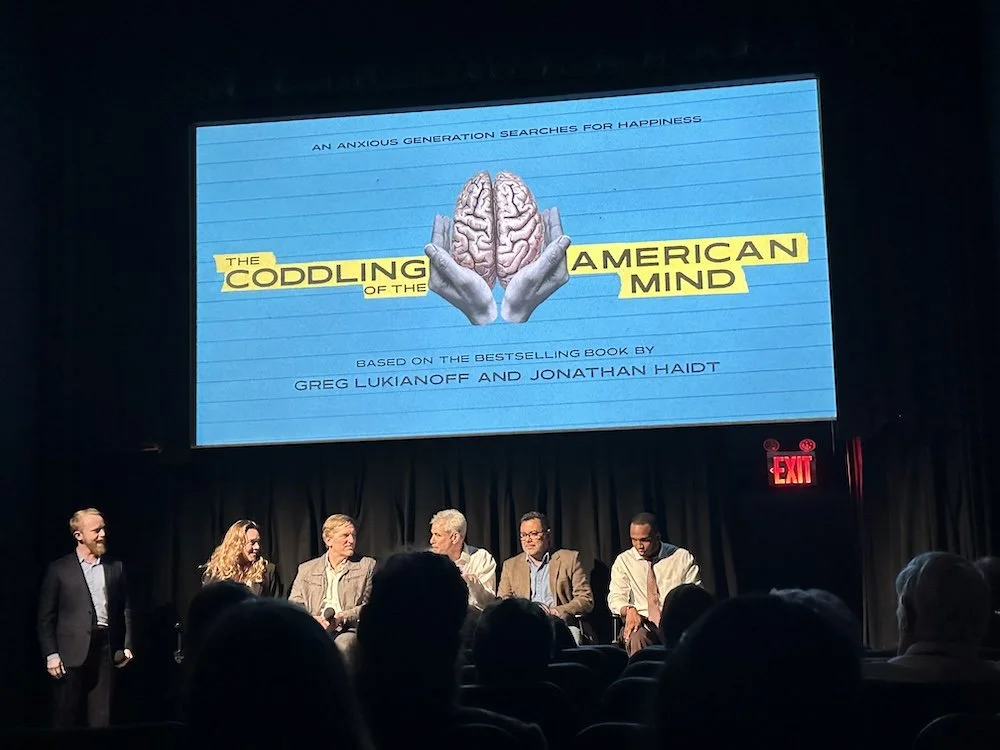
At the post-screening Q&A (L to R) moderator Brent Morden, producer Courtney Moorehead Balaker, director Ted Balaker, author and on-screen subject Jonathan Haidt, on-screen subjects Anthony Rodriguez and Saeed Malami.
My “Coddling” Story: From Alcohol and Depression to Gray Area Drinking Coach
On April 18, 2024, my husband Evan and I had the pleasure of attending a private screening of The Coddling of the American Mind documentary at the Angelika Film Center in NYC. Filmmakers Courtney & Ted Balaker, author Jonathan Haidt, and on-screen subjects Saeed Malami and Anthony Rodriguez were all in attendance for a night filled with film and conversation! Being at the screening in-person was ELECTRIC. It was so exciting to be in a room full of people from different walks of life who are also pursuing a deeper understanding of this recent troublesome shift in our society.
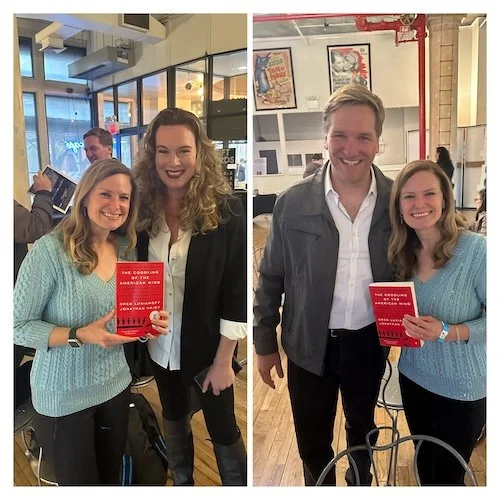
Meeting Courtney and Ted Balaker at the private screening of The Coddling of the American Mind Movie
Before the screening, we were treated to a reception of light bites and a chance to mingle with other attendees. We had a wonderful time meeting Brent Morden, who did an incredible job moderating the post-screening Q&A.
Like a kid on Christmas morning, I eagerly waited for an opportunity to have Jon sign copies of all 4 of his books that I had stuffed into my bag and ten minutes before the show I had my chance! As Jon was scribbling in my books, I shared a story about a young Millennial (who’s near the cusp of Gen Z) in my family who’s been suffering from an anxiety disorder. She had a strong reaction to a comedian that she went to see who dared to make jokes about anxiety during his set. “Anxiety is nothing to be joked about!” she exclaimed to me (just months before I had discovered Coddling). Her response left me feeling baffled and completely taken aback. I thought to myself – “Why the heck not? Where is this coming from?”
When I mentioned to Jon that she fit the demographic described in “Why the Mental Health of Liberal Girls Sank First and Fastest” (March 9, 2023), he listened intently and sighed with genuine empathy. I could tell he was all too familiar with the anecdote from countless interactions he has had since the original 2015 Coddling article was published in The Atlantic. Another young person trapped by the Great Untruths and suffering needlessly as a result.
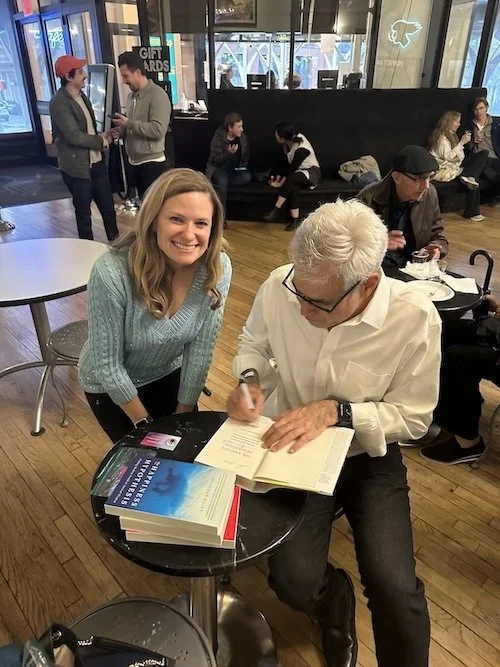
Jonathan Haidt signing my book!
Standing face to face with Jonathan Haidt was a powerful reminder of the path that lead me to this moment. At the time of The Coddling of The American Mind book publication in 2018, I was suffering from a depression and was not in a place to seek Jon’s perspective. I hadn’t been paying too much attention to the deepening polarization of politics or the changing culture on college campuses. I was too busy being immersed in a depression and struggling with severe alcohol use disorder. I had suicidal ideation and crippling anxiety, which was exacerbated by a combination of my drinking and a series of overwhelming life events. Incapable of understanding WHY this was happening to me at the time, I was drowning in negative thoughts, thinking the world was better off without me. In fact, in the Coddling documentary, when Greg Lukianoff says “I was bad, I was broken, and I had to go,” that really resonated with me. It illustrates the kind of distorted thinking that I was engaging with at my lowest point.
In early 2020, I started to move the needle with my mental health. We welcomed a new puppy into our home in January, which gave me a new purpose and something incredibly positive to focus on. Her presence helped to distract me from cravings and negative thoughts.
Shortly after the puppy arrived, I started working with a new therapist who was teaching me Dialectical behavior therapy (DBT) skills. DBT, developed by Dr. Marsha Linehan as a treatment for borderline personality disorder (BPD), is an evidence-based treatment that is derived from CBT. “It is now recognized as the gold standard psychological treatment for this population. In addition, research has shown that it is effective in treating a wide range of other disorders such as substance dependence, depression, post-traumatic stress disorders.” DBT aims to teach skills and tools needed to handle stress. The therapy consists of four modules: Mindfulness, Distress Tolerance, Emotion Regulation, and Interpersonal Effectiveness.
Just like with CBT as mentioned in the book and the documentary, DBT helps with binary thinking. In fact, dialectical means to balance opposites, and that is the main function through which DBT works. The therapist teaches the client how to hold space for multiple perspectives, rather than view experiences through a black or white lens. Learning how to change stuck, extreme thinking results in more grounded emotional states and the ability to make behavioral choices from a regulated place.
My first intro to Jonathon Haidt’s name was in early 2022, when I learned about “The Elephant and the Rider” analogy from Jolene Park during her NOURISH Method™ Coach Training. The NOURISH Method™ is specifically designed for coaches who want to successfully resource gray area drinkers. Jolene, who brought the term to the masses in her 2017 Ted Talk, defines gray area drinking as “the space between the extremes of rock bottom and every-now-and-again drinking.” In other words, gray area drinking is a wide spectrum with no “black” or “white” categories, simply lots of space in between. Millions of people are in the gray area, and in fact, this is where the majority of drinkers are. Because the medical community has established that there is no safe or healthy recommended intake level of alcohol, "moderate," "social," "problem," "dependent," and varying levels of Alcohol Use Disorder are all gray area.
The Elephant & Rider analogy is a very useful tool for fostering behavior change, a concept Jon talks about in Chapter 2, “The Untruth of Emotional Reasoning: Always Trust Your Feelings” in the Coddling book. Jon argues that we have two sides: an emotional side (the Elephant), and an analytical, rational side (its Rider). The Rider represents the prefrontal cortex, the area of the brain that can see the path ahead, make plans, and can look for patterns. The Elephant, which represents the amygdala, is motivated by fear and instinct, and can be triggered by stressors that it comes across on the path. The Elephant comes from the oldest area of the brain (from an evolutionary perspective) and is therefore more powerful than the Rider.
The Elephant vs. Rider analogy really speaks to a common frustration that I frequently hear from my clients (and experienced myself): “Why can’t I stop drinking? I read all of the books! I listen to all of the podcasts! I know this stuff!” That’s because knowing something doesn’t change something. As a coach, I help to motivate clients by tapping into the emotional (Elephant) side of their brains vs. their Rider, and by helping them set their environments (the path) up for their success, so they can make long lasting behavior changes.
Towards the end of 2022, I stumbled across a clip of Jon talking about Coddling on Real Time with Bill Maher. It caught my attention because I recognized his name from the Elephant & the Rider lesson months prior. In the clip, Jon explained how the book was inspired by Greg Lukianoff’s observations on the drastic changes that occurred on college campuses in 2013 and what spurred new “innovations” such as safe spaces, trigger warnings, and microaggressions. It turns out that because the generation born after 1995, known as Gen Z, had a dramatically different childhood (due to the influences of devices, social media, and parenting styles), it changed their social development. As a result, the rates of depression, suicide, anxiety disorders, and self-harm are way up for Gen Z compared to other generations. I was intrigued.
A few months after discovering that video clip, I subscribed to the After Babel Substack and downloaded the audiobook for Coddling. When he discussed the immune system and how anti-nut policies in schools actually helped to fuel the peanut allergy epidemic, it really clicked with me. By avoiding every possible thing that might be considered offensive or triggering, we’re creating a “princess and the pea” situation where young people have struggled to build emotional resilience. I also listened in horror to the violent student protests (coming from both ends of the political spectrum) that had been plaguing college campuses. Learning about the “words are violence” concept (which Jon refutes in the Atlantic essay, calling it a logical error) really unnerved me. I didn’t know it had gotten THAT BAD.
In a May 3, 2024 Substack, Ted Balaker posed the question, “Are you optimistic or pessimistic about the future of higher ed? Explain!” To be honest, I’ve spent many days feeling demoralized and downright worried that the future is looking pretty bleak. But as I dive more and more into this space and meet trailblazing folks like Jon, Ted, Courtney, Anthony, and Saeed, I’ve officially moved into the optimistic camp!
Part of my interest in the Coddling, is that I’d really like to figure out how to be of service to The Anxious Generation. As a Gray Area Drinking Coach, I like to say that I am in the nervous system business. I help my clients rewire their stress responses and combat anxiety using nervous system regulation, physiology, and mindfulness techniques. It’s very disturbing for me to see the rates of depression, anxiety, suicide for our young people heading into scary territory. If these young people are struggling to handle stress, then they’re likely to reach for external coping mechanisms - especially substances. As it is, young adults are “the biggest abusers of prescription opioid pain relievers, ADHD stimulants, and anti-anxiety drugs.”
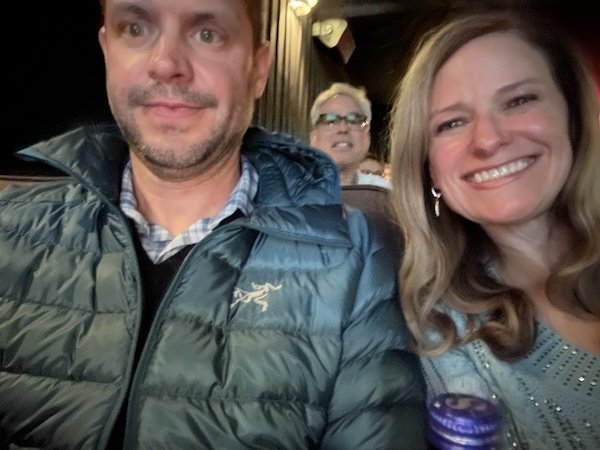
Evan and I at the pre-screening of "The Coddling of the American Mind" movie.
We don’t have children of our own, but my husband and I have plenty of children and parents in our life that we care deeply about. We’ve seen with our own eyes young children display anger, withdrawal, frustration, and tantrums all relating to devices. We’ve witnessed kids throwing expensive iPads across the room in a rage, not caring at all about the damage because “Mom will get me a new one!!” We’ve heard from parents that trying to protect their kids is an uphill battle and also they’ve noticed that when their kids have a break from devices for a period of time, they become nicer and less dysregulated. I’ve also read that myopia, or near-sightedness, and other vision problems are on the rise all over world due to increased screen time- especially among young people. Unsurprisingly, studies show that outdoor play can help lessen the prevalence of this common eye disorder.
Despite all of the negativity surrounding this subject, during the post-screening Q&A discussion, Jon made it clear that he has hope for reversing the damage done and has begun to see parents and educators evolving towards the necessary changes needed to course correct.
Evidence of change moving in the right direction is displayed by the following findings:
The Anxious Generation has been consistently on the NYT Bestseller list since it launched at the end of March. In addition, Jon has had a FULL tour schedule, showing up everywhere from Joe Rogan to Oprah!
A recent article in the Washington Post, "How a Connecticut Middle School Won the Battle Against Cellphones" shares the success story of a middle school that has been utilizing Yondr pouches. They’ve managed to keep phones out of the classroom and have reduced vaping, social media-incited arguments and the sharing of inappropriate pictures during class. Teachers are now starting their day by saying “Good Morning” instead of “Take your AirPods out.” What a concept!
In a guest post published on “After Babel” on April 29, The Revolution Has Begun in the UK, Daisy Greenwell, cofounder of Smartphone Free Childhood, reports that 75,000 UK parents have come together to give their kids a smartphone-free childhood. She says, “We have reached a tipping point in the UK. People are aware that something is deeply wrong. Parents aren’t able to bring up their children in the way that they want. We don’t need longitudinal peer-reviewed studies to tell us what we can see before our eyes. Our children are suffering. Anxiety, addiction, and anorexia are unfolding in our homes and schools.” Even the Prime Minister’s office has taken notice, inviting her and her cofounder Clare Fernyhough to come in for discussions on these issues.
Freya India also gives me hope. She’s a whip smart Gen Zer who writes incredible guest posts on After Babel (some of her posts are my favorite ones!) and has recently become a full-fledged staff writer for Jon’s team. “In A Time We Never Knew,” a Substack from April 22, she writes, “There is a beautiful and melancholic word I like called anemoia. It means nostalgia for a time or place one has never known.” She brings up how Gen Zers have making old ‘90s high school videos trend on Tik Tok and YouTube, and are fascinated with older tech gadgets such as polaroids, VHS tapes, and vinyls.
I’ve noticed this trend too. For example, I recently pulled up the trailer for the 1995 movie “Now and Then” on YouTube and the comment section backed up Freya points:
“Sometimes I wish smartphones and social media didn't exist, because now kids grow up too fast without actually having fun (I'm 16 btw).”
“I honestly wish my child hood was this instead of having technology and ppl playing Fortnite all the time.”
“This movie makes me sad because I always wanted my childhood to be like that.”
Not unlike Bill Maher, I’ve been guilty of feeling judgmental toward Gen Z. Educating myself on this topic has helped me become so much more compassionate and understanding. Freya concludes her Substack mentioned above with a sentiment that hadn’t crossed my mind prior: “…Next time you cringe at Gen Z for not coping, for not feeling cut out for this world, remember how painful it is to think that the good times are over. Then imagine how much more painful it would be to realize you never knew them.”
My journey to experiencing the screening event has left me feeling hope for change. Ted and Courtney are doing such an important service bringing Jon and Greg’s work to the masses through their inspirational documentary. They care so much about the various subject matters that they bring to the big screen and it’s clear they want to make the world a freer, more civilized place for their son and for all young people globally.
It is not easy work trying to free the anxious generation, heading into the trenches for months on end, but their passion for improving mental health and sparking change shines through.
Kristin 🫶
How I Can Help You 🌅
FREE RESOURCES PAGE FOR LOVED ONES OF THOSE STRUGGLING WITH SUBSTANCE USE disorder!
In my ongoing commitment to supporting not only those facing substance misuse challenges, but also the loved ones standing by their side, I’m excited to provide a FREE Resources page on my website.
This page is filled with valuable information, recommended books, and services designed specifically for friends and family of individuals struggling with substance use. My hope is to provide you with the tools, understanding, and support you need during such a challenging time, all in one accessible place.
You are not alone on this journey, and these resources are here to guide you with compassion and care.
VISIT MY FREE RESOURCES PAGE VIA THE BUTTON BELOW. 💜
If you want to explore an alcohol-free life or would like to improve your health, it would be my greatest pleasure to help you on your journey.
I have two different coaching options:

Health Coaching Program
Are you experiencing sickness, fatigue, depression, pain or weight issues?
If so, then your body isn’t working as it should.
There are many reasons for these health issues, and sometimes working with a Health Coach can help.
As your Health Coach, I support you through diet and lifestyle changes to help you feel the best you can and live a brighter, happier life.

Gray Area Drinking (GAD) Program
It’s challenging to change your drinking habits - especially when they’ve crept up and have been happening for a long time.
That’s where I can help you. I work holistically, focusing on your gut health, neurotransmitters, and dysregulated nervous system to calm, soothe, and get everything back in balance. I teach you coping mechanisms to deal with cravings and give you all the tools you need to live an alcohol-free life.
Take the first step to brighten your life!
Book your FREE consultation to learn more about my Health Coaching and Gray Area Drinking Coaching programs and how I can help you.
Remember…
EVERY DAY IS A GOOD DAY TO BE ALCOHOL-FREE, and SUNSETS ARE THE NEW HAPPY HOUR! 🌅
Kristin ❤️ x